Jotform and FORM.com both offer workflows. Rubicon’s case is more specific: customer-built forms and processes with accessibility authoring gates, version-pinned execution and evidence-gated releases.
Official documentation reviewed November 3, 2026. “Not verified” means the reviewed sources do not establish equivalent functionality—not that the product cannot offer it. Features may depend on the competitor’s plan.
What matters
RubiconBuilt here
Jotform
FORM.com
Accessibility before publication
Catch authoring errors before respondents encounter them.
Rubicon: Built in
Blocking checks refuse publication for missing labels, unlabelled choices and other defined authoring errors. Delivered form fields are tested against WCAG 2.0 A/AA.
Jotform
Documents form accessibility analysis and warnings. The reviewed guide does not establish the same blocking publish gate.[1]
FORM.com
Equivalent publish-blocking checks not verified in the reviewed workflow documentation.[5]
Stage → QA → Production
Test a change before it reaches live respondents.
Rubicon: Built in
An immutable release bundle pins forms, processes and lookup versions. Promotion requires Stage test evidence, QA testing and QA approval; later QA activity invalidates earlier approval.
Jotform
Enterprise Draft Mode documents draft/live separation and publishing—not the same three-environment, evidence-gated release sequence.[4]
FORM.com
The reviewed workflow page does not establish an equivalent release sequence or QA approval gate.[5]
Keep running cases on their versions
A new process must not silently rewrite work already underway.
Rubicon: Built in
Every submission records its form version. Each case retains its process and release versions, and resumes on those definitions after later promotions.
Jotform
Form revision history and restoring earlier revisions are documented. Equivalent case-level form/process/release version pins were not verified.[3][4]
FORM.com
Task tracking is documented. Equivalent immutable case-level version pins were not verified.[5]
Visual editing + readable definitions
Review the actual rules, not just the screen layout.
Rubicon: Built in
Customers build their own forms and processes visually or in YAML. Each builder edits its canonical definition; process versions can be compared by stable step IDs.
Jotform
Documents a visual workflow builder with forms, tasks and logic. Equivalent canonical YAML editing was not verified.[2]
FORM.com
Documents configurable forms, custom data models and workflows. Equivalent canonical YAML editing was not verified.[5]
Work after the submit button
Intake needs ownership, routing and a recorded outcome.
Rubicon: Built in
Submissions start cases with branching rules, assignment, a shared queue, approve/reject actions and an audit history. Clarification replies append without changing original answers.
Jotform
Supports workflows, tasks, individual and team approvals, and logic. Workflow capability is not unique to Rubicon.[2]
FORM.com
Documents assigned tasks, tracking and reassignment for enterprise operations. Workflow capability is not unique to Rubicon.[5]
A constructor for your organisation. Not a form built for you.
Sign up, name your workspace and create your first form. Build the process it starts, review changes and promote the versions you approve. Your team owns the definitions and the work.
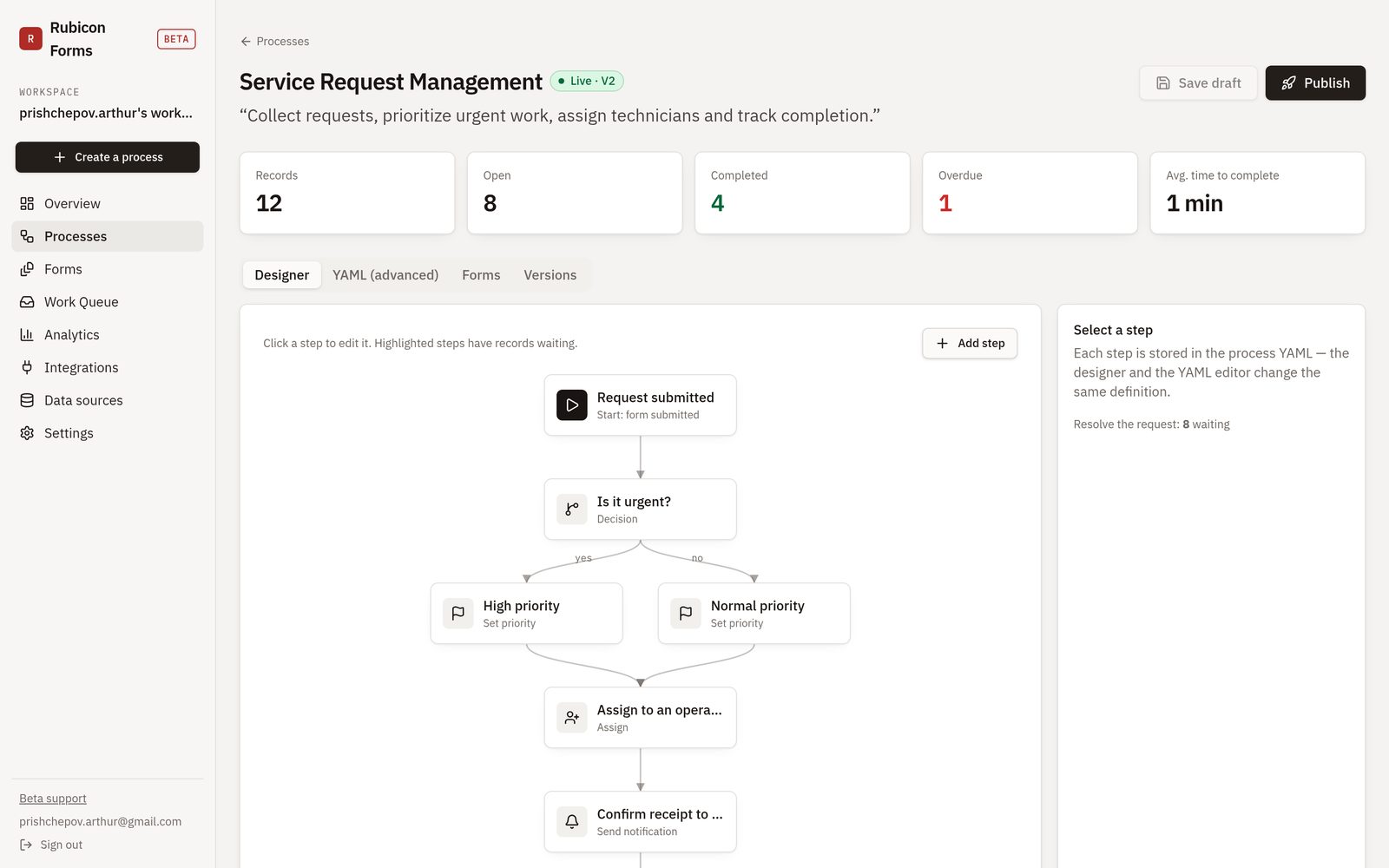
The Rubicon process designer, captured from the product with sample data.
A strong fit when forms drive operational work and you need to know which definitions were tested, who approved them, and which version every case used. Basic collection and approval workflows alone are not unique advantages over the products above.
Know the boundaries, too.
Rubicon is in public beta. Parallel reviewer approvals are available; arbitrary parallel process branches, automatic retries and SLA escalation are not yet available.
Stage, QA and Production are logically separated, not physically separate databases.
AODA/WCAG 2.0 AA is the design target for customer-delivered forms. Automated authoring checks and rendered-field tests are not independent accessibility certification or a guarantee of legal compliance.
ERP hand-off uses webhooks and your integration endpoint—not certified native ERP connectors. Email delivery requires a configured sender domain.
FORM.com here refers to the enterprise platform at form.com. The separate forms.com domain was not evaluated. Jotform and FORM.com are their respective owners’ trademarks; Rubicon is not affiliated with or endorsed by either. This comparison is published by Rubicon, not an independent reviewer.